
Introduction of American Flag changes
The Star and Stripes banner is one of the most recognizable images of democracy. It stands for solidarity across the globe. Since its adoption in 1777, it has undergone multiple insignia changes, signifying the growth of the United States of America. Each alteration shows the inclusion of new member states, sculpting the flag into its contemporary design. This article explores the historic evolution of American flag design. It covers modifications from its original versions. It also includes today’s well-known Stars and Bars.
The First American Flag (1777)
The Continental Congress passed the Flag Act on June 14th, 1777. This act established the first official American flag. The resolution stated that the flag of the thirteen United States must have thirteen stripes. These stripes should alternate between red and white. The union must consist of thirteen stars, white in a blue field. This symbolizes a new constellation.
This flag is often credited to Betsy Ross. It had 13 stars arranged in a circular pattern. This arrangement denoted the unity of the original 13 colonies. Although no official pattern was mandated, variations existed, with some featuring staggered or linear star arrangements.
The Star-Spangled Banner (1795-1818)
Vermont and Kentucky joined the Union. After this, the flag was modified in 1795. It included 15 stars and 15 stripes. This was the only period the flag had over 13 stripes. This version motivated Francis Scott Key to pen The Star-Spangled Banner during the War of 1812.
The Return to 13 Stripes (1818)
By 1818, five more states had joined the Union. Congress redesigned the flag to keep a functional design. They passed the Flag Act of 1818. This act reduced the number of stripes back to 13 to honor the original colonies. It added a star for each new state. Since then, a new star is included on July 4th after a state’s admission.
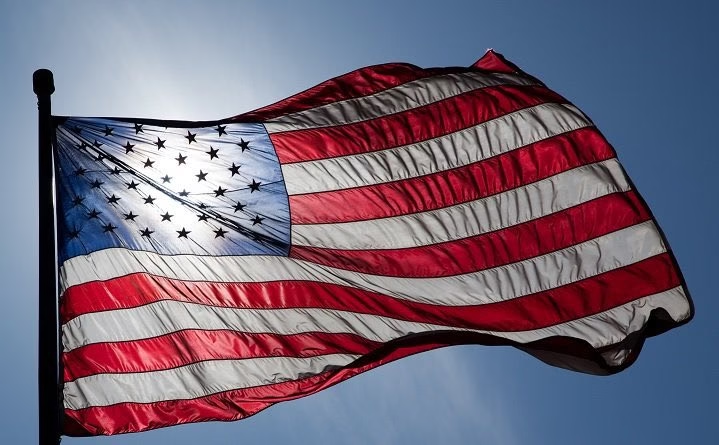
Significant Iconic Symbol Alterations Over the Centuries
A twenty-six star depiction (1837-1845) featured twenty-six luminaries. These were organized in an assortment of arrangements, including elliptical and staggered formations, after Michigan’s accession.
Thirty-one stars waved (1851-1858) upon California’s statehood directing western growth.
Despite separation, the banner preserved thirty-four representations (1861-1863) including dissenting factions symbolizing hope for reunification.
Thirty-eight stars stretched wall to wall (1877-1890) after Colorado’s induction onto the expanding nation.
For nearly half a century, a consistent forty-eight star standard waved (1912-1959) through global conflicts. In 1959, Alaska elevated the whole to forty-nine to mark its entry. This introduced irregularity for the first time in a century.
On America’s birthday in 1960, Hawaii became the fiftieth state. This added the longest serving symbolization of fifty stars as the present emblem.
Symbolism of the American Icon
Luminaries: Represent the fifty states united
Stripes: Originate from the thirteen original colonies
Colors:
Red: Valor and fortitude.
White: Purity and rectitude.
Blue: Justice and perseverance.
FAQs
What was the earliest American symbol design?
The primary adopted emblem in 1777 contained thirteen stripes and thirteen stars organized in a ring or other patterns.
How many official alterations has the American icon undergone?
Twenty-seven official changes have occurred since the icon’s adoption in 1777.
Why did Old Glory return to 13 stripes once more?
In 1818, our nation’s lawmakers decided to keep the original 13 stripes to honor the first colonies. They added stars for each new state as they arrived.
When was the most recent change come to the stars and stripes we hold so dear?
The earlier update occurred on July 4th, 1960, when Hawaii joined as the fiftieth state in our union.
Does the possibility exist of a flag boasting 51 stars waving free?
Should a new state like Puerto Rico or Washington D.C. join us, it is our banner will need a redesign.
What happens then if one more state is welcomed to the fold?
A new star would be added on the July 4th after their admittance. This continues a tradition set way back in 1818.
Conclusion
Our flag’s design has evolved alongside our country, reflecting our history, growth, and strength through all. From the original 13 stars simple flag to today’s flag with 50 stars. Each change tells the story of our expansion and unity. While the current version has remained for over 60 years, new states will still be added. Thus, future updates can’t be ruled out.